Tuesday, December 11, 2007

Word of the Year

Another 4pm-in-the-afternoon blog entry; I'm not sure these really count as they are invariably short.

At any rate, Merriam-Webster Online is inviting those of us who lurk on the Web to vote on the Word of the Year 2007. Interesting list, although I'm not sure why some of those words are there. I mean, occasionally one does yell out "w00t!" while sitting in front of the computer monitor, but I'm not sure that a word spelled with double-zeros in the middle contributes to the language much. Words like charlatan and Pecksniffian have been around for a long time, and I can't say that 2007 deserves them more than any other year I've suffered through. But there is a word that's applicable to us book-blogging types and one, I'm sure, that has been sadly under-utilized. Sardoodledom. Now there's a word! It specifically applies to drama and is used to suggest a mechanical plot and bad characterization in the work. That's the one I'm voting for.

So that next bad DVD you fling at the wall in disgust after losing 90 minutes of your life? Just blog about it and use the word "sardoodledom". The rest of us will know what you mean.

Sunday, December 09, 2007

Tall, Decaf, No-Foam Latte, Please

It's a picture of Santa at Starbucks. Better yet, a librarian took the picture so you can trust its veracity...

Saturday, December 08, 2007

After Jack Armstrong Got Out Of The Snake Pit

Where to begin? My husband tells a story about an old radio serial where a hero had been written into so tight a corner at the end of one episode, that the writers resorted to opening the next episode with “After Jack Armstrong Got Out of the Snakepit...”, so they wouldn't have to explain how the hero had escaped all the difficulties. Suffice it to say that my absence has been due to a need to climb out of the snake pit. But during that period, while largely idle and unproductive to all appearances, I did read some and watch some good material.

For example:

Slings and Arrows (http://en.wikipedia.org/wiki/Slings_and_Arrows) – The Canadians have been holding out on us! This is a wonderful television series about a theater troupe of professionals who do a sequence of Shakespearian plays (Hamlet, Macbeth and King Lear). Each season corresponds to a single production. Our priest at church recommended the series to us and Patrick and I fell in love with it. Love factors in, the performing arts collide with the business of theater, and the various characters rotate through various stages of life. The first season started a bit on the slow side, but gathered momentum. Patrick and I watched the second season in a single weekend, just because we couldn't bear to wait to find out what happened. The acting is amazing. If you are looking for a good Christmas gift for someone this year who is involved with the arts, I do recommend this set of DVDs.

Silent in the Grave – JenClair had written about this one some while back and I'd had it sitting on the shelf but didn't get around to reading it until literally this past week. It might have done with some good editing to tighten up the pacing but all in all, it was fun with some fun twists. I thought her male lead was a little too brooding and dramatic, but should you need something both interesting and frothy during the holiday season, I'd recommend this one. The author, Deanna Raybourn, has a new one out at the moment as well featuring the same set of characters, called Silent in the Sanctuary and a third one in the works, Silent in the Moor.

The Dead Secret – Wilkie Collins. Yes, he writes pure, somewhat implausible Victorian melodrama. But he's so good in some ways. He can take a page or more to describe a single incident of catching sight of a servant in a doorway and have that image arrest you and tell you more about that character than most modern writers would think necessary or interesting. Yet it works. You care about that woman and her role in the household at that moment of the mistress' death.

In Praise of Slowness – Carl Honore. This one was disappointing. I expected more depth to the research backing up his points, but he relied too much on the anecdotal without adding practical advice for executing a more balanced life style. I much preferred a book by Margaret Guenther entitled At Home in the World: A Rule of Life for the Rest of Us. She bases her thinking on the Rule of St Benedict and understands how the pressures of modern life sometimes can preclude what seem like fairly basic common-sense behaviors. No guilt but understanding and encouragement for making the attempt to bring oneself back into balance.

Finally, just this afternoon I read this story about depression, Martha Stewart and making Christmas cookies. http://www.thestranger.com/seattle/Content?oid=445158. It's charming.

By the way, if you're experiencing winter at the moment in terms of chilled air, snow flakes, etc., you might want to consider a great baked potato with toppings for lunch - cheese, salt and pepper, bacon bits. Warms you right up! Oh, and I had meant to tell you that I got a great little laptop during November.

May I say, how much I missed all of you?

Saturday, November 10, 2007

Why I Haven't Blogged in Two Weeks


As Pogo says, "We have met the enemy and he is us." I noted that Lisa over at BlueStalking Reader has been writing this weekend about the pace of her life and the frenzy of energy required to keep up with daily affairs. Now Lisa is doing an amazing amount -- working, grad school, etc. -- but I will admit that I experience the same difficulty of maintaining a balance between all the different sectors of my life.

The past month has featured business travel, the usual number of ordinary work-days, two book discussion groups, and the first vacation I think I have taken in about two years. (There was a reason I titled the previous entry "Brain Dead But..."). I got to visit one of my sons during that period and had two separate visits with friends. Essentially, I didn't need mental stimulation; I needed sleep and gentle diversion. My computer time consisted of dutifully checking my work email twice (in case of crises) but I didn't even have the energy to blog as my husband noted with surprise. But the brain felt a whole lot better after the rest. All of this to suggest that I may go out of my way to pick up the book that Lisa has been reading and quoting on her blog -- In Praise of Slowness: How a Worldwide Movement Is Challenging The Cult of Speed by Carl Honore.

Tomorrow will feature a book review, maybe two. But I'm not going to push it. More business travel looms. The thought did occur that maybe we need a recession in this country just to slow everyone down. But there really ought to be a better way...

Friday, October 26, 2007

Brain Dead, But This Made Me Laugh


My friend, Cindy, brought this to my attention; she's attending one of the conferences I should be attending this weekend. She used Twitter (see box on right) to let me know what was going on.

Friday, October 19, 2007

To Husband and Sons

You need to read this. I'm neither weird nor obsessive. And, as a general rule, I don't buy four per year.

Thursday, October 18, 2007

Nifty Thing From New York Public

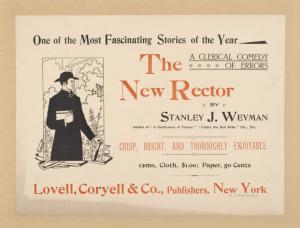
The New York Public Library has now made it possible for bloggers to embed images from their Digital Gallery into blogs, websites, etc. As I have done with this commercial poster advertising a book...

One of the most fascinating st... Digital ID: 1543071. New York Public Library

Kind of nifty, isn't it?

What I've Been Reading (Lots of Short Stuff)

For reasons unfathomable to man, I have recently read the following:

The Elephant's Child by Rudyard Kipling. I am chagrined to note that I got it confused with the Golden Book about the Saggy, Baggy Elephant. That's what middle-age does to you. After all, how does one forget about 'satiable curtiosities...

The Frozen Deep by Wilkie Collins. Deeply satisfying Victorian melodrama. Based upon a play which Collins co-produced with Charles Dickens, the story was something of a response to the dreadful rumors of cannibalism in the wake of the disastrous Franklin expedition to the North Pole in 1845. I was reading the Hesperus Press edition (worth every penny).

Also by Wilkie Collins, Miss Jeromette and The Clergyman. A somewhat gothic short story.

And if you're in that kind of Victorian mood, check out Good Lady Ducayne. I can't tell you anything about it lest I give away the ending. But really rather fun...

More later. I'm in and out a lot this month, traveling for work.

Saturday, October 13, 2007

Joseph Conrad's Heart of Darkness [Review]


An entry in the RIP II Challenge

Title:
Heart of Darkness

Author: Joseph Conrad

Copyright: Initially serialized in 1899 and published as a book in 1902; this text is in public domain. I read the Everyman's Library edition (1993, Knopf, New York).

Genre: Fiction

Length: 110 pages

Summary: A party of five men at their leisure on a yawl within sight of London listen to one man, Marlowe, tell of his experience in working for a Belgian enterprise in Africa as a steamship captain. He recalls his journey into the jungle to take supplies up the Congo river to a station agent, Mr. Kurtz. We hear Marlowe describe the intimidating nature of the jungle environment, the Company employees who fritter away time and resources, the ill-treatment of black laborers, and the strange personality cult that has arisen around Mr. Kurtz as he wields monarchical powers in the depths of the jungle. Kurtz, by the time Marlowe finds him, is deathly ill and those who surround him present odd perspectives of his role and influence in the jungle setting. After an illness, Marlowe subsequently returns to England, himself a changed man who may or may not be able to articulate the substance of his experience.

There is a good deal of the hallucination and nightmare in Marlowe's story. Conrad has Marlowe provide us with a fragmented set of events and expects us to add in those details left outside the printed page while inviting the reader to come to his/her own conclusions as to the point.

Extract: "They shouted, sang; their bodies streamed with perspiration; they had faces like grotesque masks--these chaps; but they had bone, muscle, a wild vitality, an intense energy of movement, that was as natural and true as the surf along their coast. They wanted no excuse for being there. They were a great comfort to look at. For a time I would feel I belonged still to a world of straightforward facts; but the feeling would not last long. Something would turn up to scare it away. Once, I remember, we came upon a man-of-war anchored off the coast. There wasn't even a shed there, and she was shelling the bush. It appears the French had one of their wars going on thereabouts. Her ensign dropped limp like a rag; the muzzles of the long eight-inch guns stuck out all over the low hull; the greasy, slimy swell swung her up lazily and let her down, swaying her thin masts. In the empty immensity of earth, sky, and water, there she was, incomprehensible, firing into a continent. Pop, would go one of the eight-inch guns; a small flame would dart and vanish, a little white smoke would disappear, a tiny projectile would give a feeble screech--and nothing happened. Nothing could happen. There was a touch of insanity in the proceeding, a sense of lugubrious drollery in the sight; and it was not dissipated by somebody on board assuring me earnestly there was a camp of natives--he called them enemies!--hidden out of sight somewhere."

Also Relevant: This is for many a controversial book. In 1977, Chinua Achebe wrote an essay, challenging the continued praise heaped on Heart of Darkness and stressing its inherent racism on the basis of Conrad's inability to see African society as being of equal stature with that of European society. Certainly, Heart of Darkness spells out the incomprehensibility that Africa represents for Marlowe (and by extension, Conrad); he is unable to understand the language, finds navigating the physical environment both intimidating mystifying, and ultimately is unable to account for the behaviors of any humans in this setting. The baffled conclusion to Marlowe's tale to his fellows expresses that lack of comprehension; he does not know how to go forward in civilized life now that he has returned to London. He cannot reconcile man's interior purpose with civilized man's history, having seen Kurtz in Africa. He speaks of having wrestled with a man's soul while being unable to express the essence of the man to those who pursue Kurtz even after death.

I sat and scribbled in my moleskine for several pages, trying to frame what I thought of this book. The themes are rather numerous for working through the author's point. One can focus on colonialism, light vs. darkness, constant movement inward (we know nothing of how Marlowe makes his way back to London) and at least another dozen concepts found in the text. Thinking about it from another standpoint, the Fowler and TipTree short stories discussed here owed a good deal to Heart of Darkness. I realized it only once I'd really finished the book. But everything and everyone is "The Other" in Conrad's world. I think Conrad's point was that there is a mystery to our existence that we may never fathom (the real heart of darkness). We can look inward for as long as we wish and we may never find an answer to that mystery; if too obsessed by the inquiry, we may even drive ourselves mad.

I need more time to think about this one.

Monday, October 08, 2007

The Prestige: Book and Movie [Review]


[ For both the RIP Challenge II and the Books into Movies Challenge ]

The Prestige by Christopher Priest (Tor Books (2006), Mass Market Paperback, 368 pages)

The Prestige: The Screenplay by Jonathan and Christopher Nolan (
Faber & Faber (2006), Paperback, 112 pages)

This is another two-for-one style review, just as I did earlier this month with Dr. Jekyll and Mr. Hyde and Mary Reilly.

My husband and youngest son brought the movie to my attention and subsequently the book as well. The book, originally published in 1995, had won the World Fantasy Award and the movie, which came out in 2006, was nominated for an Oscar in two of the lesser technical categories. Both my husband and my son found the movie to be intriguing -- to the point of watching the film multiple times. The book, according to my husband, was rather "creepier" than the movie and he recommended it. One day this past summer, while folding laundry or some equally mundane task, I got caught up in watching the movie version of The Prestige on cable. The movie got my attention because I couldn't fathom quite where it was going, given the plot twists, and I became deeply engaged in working out the puzzle. Subsequently, as my husband had thought it was rather interesting, I thought I'd read the original novel for the RIP Challenge this year. (After all, creepy is one of the necessary criteria.)

You would think that, having watched the movie, reading the book would be somewhat anti-climactic. After all, the reader/viewer knows the secret of how the stage magicians pull it all off. But that is not actually the case in this instance; the original author and the film screenwriters tell the same story with some slight differences and each version is wrought so carefully that the story-telling in each produces a satisfying experience.

The introduction to the screenplay describes the difficulty of transmuting the novel into a movie. Specifically, Jonathan Nolan writes, "The first step of adapting a brilliant book is heresy -- you have to throw it all out, then watch as piece by piece, it creeps its way back in, with a smile, as if to say, 'I told you so'. The biggest challenge was the structure." Priest's novel is structured in five sections (4 individual perspectives and a final dual view of events). It has a modern day setting and a setting in the late Victorian period. We hear the voices of two men, Rupert Angier and Albert Borden, and the voices of two of their descendants. Nolan, in modifying the story for the screen, drops out the modern element. All of the focus is on the two men in the 19th century, vying with one another for the premier position in their field. In the film, the triggering event for the artists' feud which builds into obsession is different from that of the text, but the screenwriter hasn't the luxury of the slower build-up employed in the book. Both handle the growing conflict plausibly and with interest.

Class is a significant element in the story of these two men, one the son of a carpenter and the other the son of a titled lord. Film conveys the class aspect rather more subtlety (costume, set design, etc.) than the book. Angier and Borden adopt different avenues of approach in choosing how they will succeed; one chooses an elaborate creation of illusion and the other calls upon science to manufacture the surprising end of his act. (The scientific element is how the figure of Nikolai Tesla enters into the story.). The surprise, the pay-off, in both book and film is how the clues are laid before the reader. If you are clever in following the clues, can you see where this story will ultimately end? It's rare (in my experience) to feel a need to watch a movie twice as well as read the book twice in order to closely track how the craft in telling the story is managed so that the resolution is not immediately obvious.

The themes here are duality (just as in Jekyll and Hyde) and the trade-offs associated with an upward struggle (just as in Mary Reilly). Are those who appear to be dead truly dead? Or will they return to the stage, whole and unexpected? Disguise is as much a part of the illusionist's craft as diversion. The touch of the gothic makes film and book just bit darker; one isn't necessarily scared as with The Woman in Black, but there is that level of discomfort, that quality of what my husband called "creepiness". Intellectual creepiness of the sort that makes you think -- when all you thought you were getting was either a popcorn flick or a fast read.

They are wonderfully crafted and enjoyable. If you have time to read, go for the novel; if you have only two hours of leisure, pick up the DVD. If you are stuck in the house over a gloomy, rainy weekend, do both.